
You toss a load of wet clothes in the dryer, hit start, and come back 45 minutes later expecting warm, dry laundry. Instead, everything comes out just as damp as it went in. The drum is spinning, the machine sounds normal, but there is no heat. Just cold air. It is one of the more frustrating appliance problems you can deal with, mostly because it is not obvious at all what is wrong.
In majority of cases, it is a single failed component, and once you identify which one, the repair is straightforward. This guide walks you through every likely cause, how to check for each one yourself, and what to expect if you need a technician to step in. Whether you have an electric dryer with no heat or a gas dryer blowing cold air, the answers are here.
If you have been dealing with other appliance issues at the same time, our full appliance repair services in Charlotte page covers everything we handle across the home.
Why Does a Dryer Run But Produce No Heat?
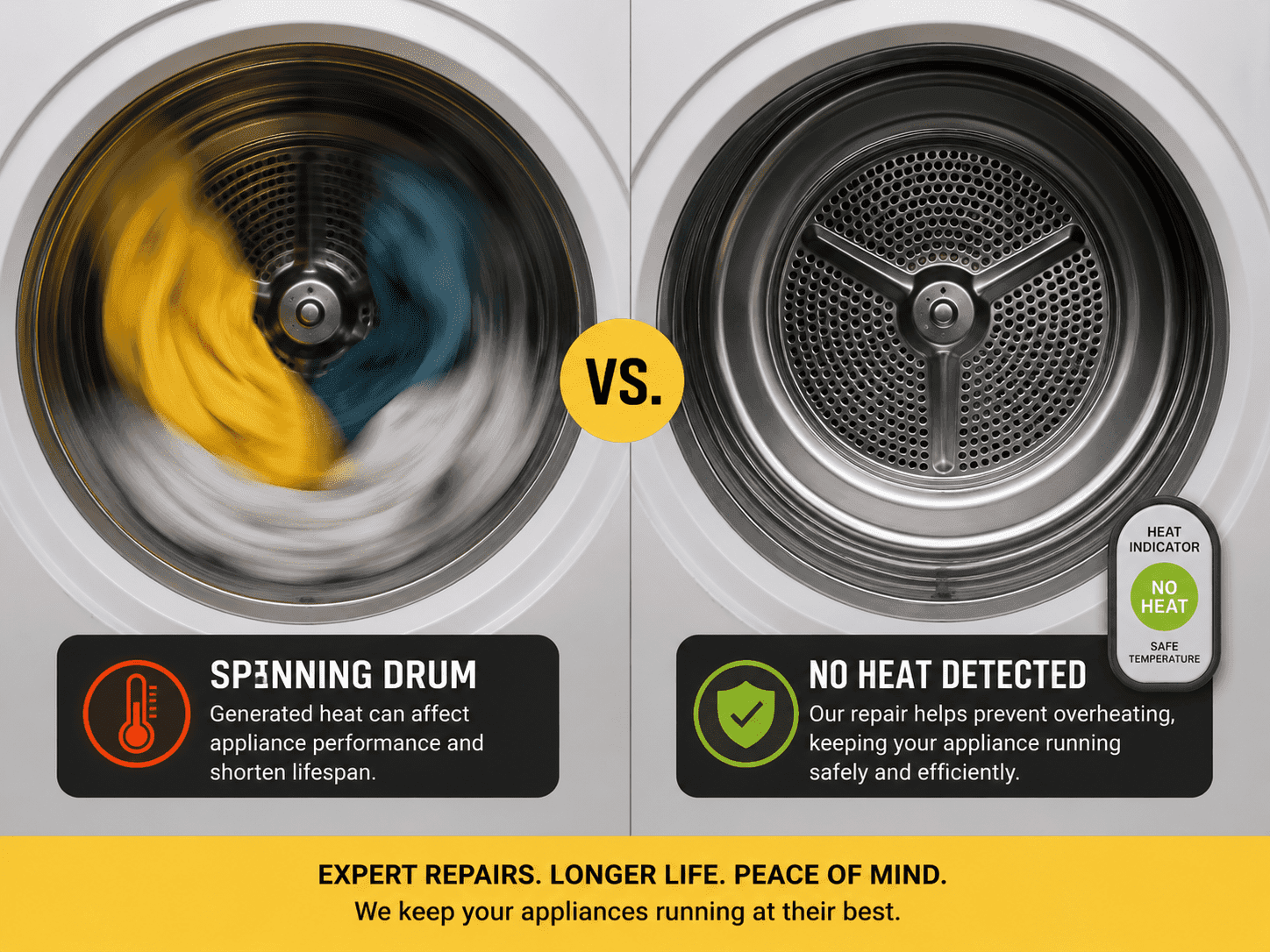
When your dryer runs but is not heating, the motor, drum, and controls are working fine. The problem is isolated to the heating system specifically. On an electric dryer, that means the heating element and its associated thermal components. On a gas dryer, it means the gas valve, igniter, or flame sensor system.
The good news is that neither type requires a full dryer replacement in most scenarios. What usually holds heating problems back from being diagnosed correctly is the assumption that because the machine “works,” the repair must be complicated. It usually is not.
According to the U.S. Consumer Product Safety Commission, clothes dryers are involved in roughly 2,900 home fires each year, and failure to clean is the leading contributing factor. A dryer that stops heating properly is often sending an early warning about a vent or thermal safety issue worth taking seriously.
The Most Common Reasons Your Dryer Is Not Heating
Is a Clogged Dryer Vent the First Thing to Check?
Yes, and this is the one most homeowners completely overlook. A blocked or restricted dryer vent is the single most common reason a dryer stops heating effectively. When hot, moist air cannot escape the drum properly, the dryer’s thermal safety system cuts off the heating element to prevent a fire. You end up with a drum that tumbles but never dries anything.
Signs your vent may be the problem:
- Clothes are damp after a full cycle
- The dryer feels unusually hot on the outside
- Laundry room smells musty or faintly like something is burning
- Drying times have gradually gotten longer over recent months
Pull the dryer away from the wall and check the vent hose running to the exterior. If it is kinked, crushed, or visibly packed with lint, that is your culprit. Even if the hose looks fine, the exterior vent cap can be fully blocked from the outside.
At A1 Appliance Repair, we include a free dryer vent inspection with every dryer repair order (double visit). We see this scenario regularly. A client calls in with what sounds like a heating element issue, and the actual problem turns out to be a vent that has not been cleaned in three or four years. Fixing the vent fixes the heat.
For professional dryer vent cleaning across our service area, visit:
The National Fire Protection Association (NFPA) recommends cleaning your dryer duct at least once per year, and more often if you run multiple loads weekly.
Is a Blown Thermal Fuse Causing Your No Heat Problem?
Almost certainly, if you have an electric dryer and the heat stopped completely all at once. The thermal fuse is a one-time safety device that blows if the dryer overheats, permanently cutting power to the heating element until it is replaced. It does not reset itself. Once it blows, no heat until you swap it out.
On most dryers, the thermal fuse sits on the exhaust duct inside the back panel. Testing it requires a multimeter set to continuity. No continuity across the fuse means it is blown. Replacement fuses cost $5 to $15 and take about 30 minutes to replace.
If your thermal fuse blew, something caused it. Replace the fuse without addressing the root cause (usually a clogged vent or a faulty cycling thermostat) and the new fuse will blow again, sometimes within weeks.
Symptom | Likely Culprit |
No heat at all, electric dryer | Blown thermal fuse |
Dryer heats sometimes, not always | Cycling thermostat |
Dryer heats but shuts off too quickly | High-limit thermostat |
Dryer runs cold, gas model | Igniter or gas valve coils |
Dryer takes 2+ cycles to dry clothes | Clogged vent |
No heat after a storm or power surge | Control board |
What Happens When the Heating Element Fails?
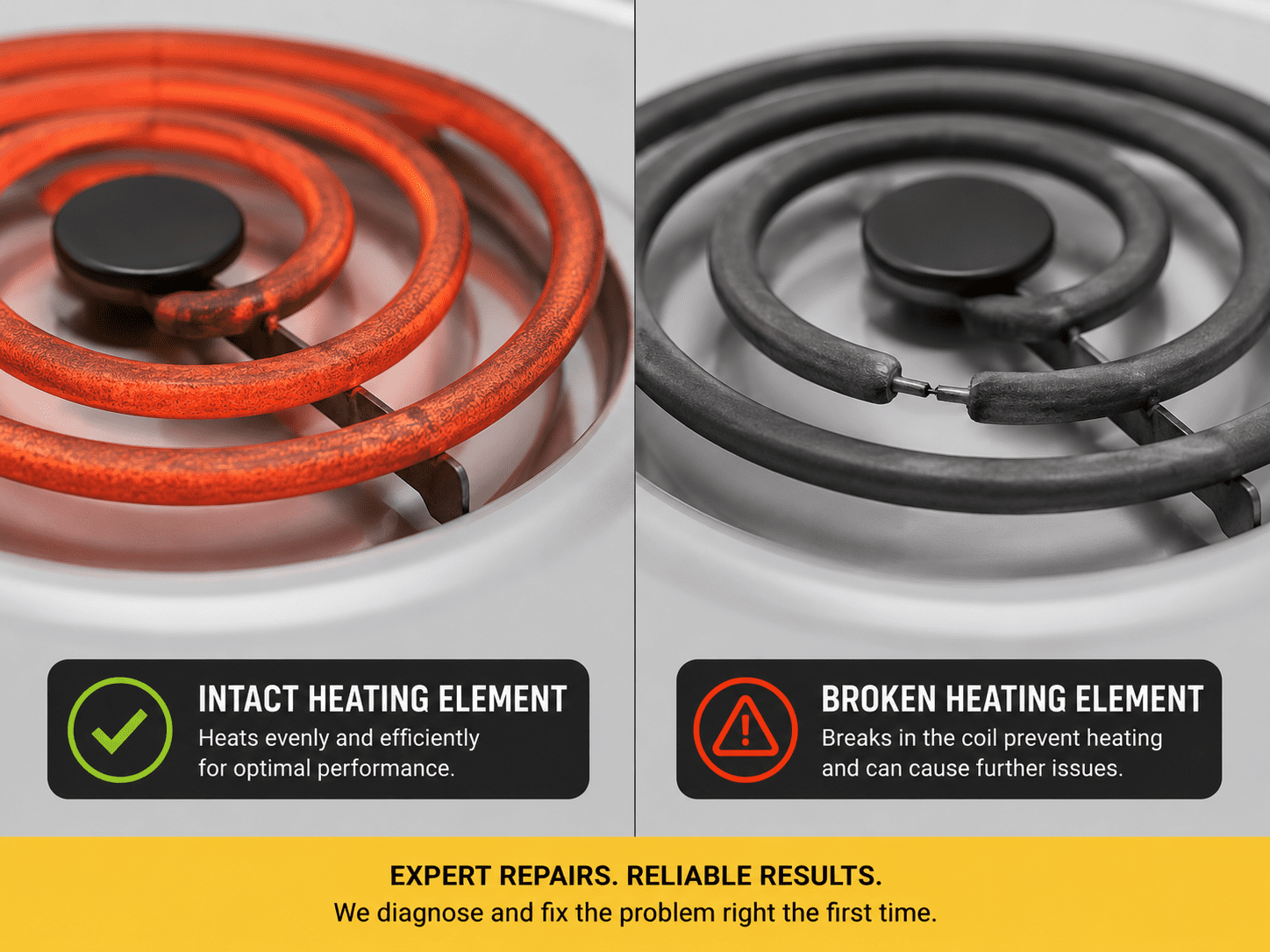
On an electric dryer, the heating element is a coiled wire inside a metal housing. It heats up when electricity passes through it, warming the air that circulates through your drum. When the coil breaks, you get exactly what you are dealing with: a dryer that runs but produces zero heat.
You can often spot a failed heating element visually once you remove the back panel. Look for a break or burn mark in the coil. A multimeter test will show no continuity across a broken element. Heating elements for most common brands cost between $20 and $80 and are accessible to replace if you are comfortable working inside appliances.
This is one of the most frequently diagnosed issues our technicians handle. If your machine is a Whirlpool, GE, Samsung, LG, or Maytag, the heating element is a known wear component and parts availability is rarely a problem.
Could the Thermostats Be the Problem?
Dryers use multiple thermostats, and any of them can cause heating issues without producing obvious visible symptoms.
Cycling thermostat: Regulates temperature during the drying cycle. If it fails in the open position, the heating element never gets the signal to activate.
High-limit thermostat: A secondary safety cutoff for dangerously high temperatures. A stuck high-limit thermostat can block heating entirely even when the element itself is fine.
Felt temperature sensor (newer models): Digital sensors on modern dryers can fail and send incorrect temperature readings, causing the heating circuit to shut down prematurely.
Testing each thermostat for continuity is straightforward with a multimeter. What is less straightforward is knowing which one failed when multiple components test fine visually. This is where a technician running a full diagnostic saves you from replacing the wrong part repeatedly.
Why Would a Gas Dryer Blow Cold Air?
A gas dryer not heating involves a completely different set of components. If yours runs but produces cold air, the problem almost always lives in one of three places.
The igniter: The igniter glows red-hot to ignite gas coming through the valve. Over time, igniters crack or burn out entirely. During a cycle, you can sometimes watch through the small opening near the burner assembly. If the igniter glows but the gas does not light, or if there is no glow at all, that is your issue.
Gas valve coils (solenoids): The gas valve uses small electromagnetic coils to open and allow gas to flow. These coils fail more often than the valve itself. A failed coil means the valve stays closed, gas never reaches the igniter, and the dryer blows cold air. Coil kits are affordable but diagnosing which coil failed requires testing.
Flame sensor (radiant sensor): This sensor detects whether the burner is actually lit. If it fails, it can prevent the gas valve from opening on subsequent cycles even when the igniter is working.
The U.S. Department of Energy notes that gas dryers are generally more energy-efficient than electric models for heat production, which makes keeping them well-maintained especially cost-effective over time.
What About the Timer or Control Board?
On older mechanical dryers, a faulty timer can break the heating circuit without any visible indicator. The drum keeps turning because the motor runs on a separate circuit, but the heat setting on the timer dial has lost its internal connection.
On newer electronic dryers, the control board manages the entire heating sequence. A failed board is less common than a thermal fuse or heating element, but when it fails, the symptoms can mimic almost anything else. Control boards are also the most expensive single component to replace, which is exactly why a good technician rules out everything else before pointing there.
If your dryer recently experienced a power surge, the control board is a reasonable suspect. We see this fairly often after storms in the Charlotte area. It is also worth noting that washer repairs often follow dryer repairs in the same service call. If your washer has been acting up too, our washer repair service covers the same makes and models.
Can a Power Supply Problem Cause No Heat?
This applies specifically to electric dryers and catches a lot of homeowners off guard. Electric dryers run on a 240-volt circuit fed by two separate 120-volt legs. If one leg of that circuit trips or blows a fuse, the dryer can still run on the remaining 120V while the heating element, which needs the full 240V, gets nothing at all.
Check your breaker panel. If you see a tripped breaker for the dryer, flip it fully off and back on. If it trips again immediately, there is likely a short in the heating circuit or a wiring problem that needs a professional to diagnose safely. Do not keep resetting a breaker that keeps tripping.
How to Diagnose Your Dryer Not Heating Step by Step
Before calling a technician, a few quick checks can help you understand what you are dealing with:
- Check the vent first. Disconnect the vent hose and run a short cycle. If heat comes back, you have a blockage. Do not run the dryer this way long-term; it is a fire risk and should be addressed immediately.
- Check the circuit breaker. Look for a tripped breaker in your panel. Reset it and try again.
- Listen and watch at the gas burner. On a gas dryer, watch for the igniter to glow orange during startup through the burner access panel. No glow means a failed igniter.
- Note how long the dryer has been in service. Thermal fuses rarely blow on new machines. If yours is 7 to 10 years old and heat stopped suddenly, the thermal fuse is the most likely cause.
- Look for error codes. Many modern dryers display fault codes. Check your owner’s manual or search your model number plus the code to narrow the diagnosis fast.
For Charlotte area residents, our emergency appliance repair blog post covers what to expect when you need same-day service.
How Much Does It Cost to Fix a Dryer That Is Not Heating?
Repair costs vary by the part that failed. Here is a realistic breakdown based on what we typically see in the Charlotte, Concord, Hickory, and Winston-Salem markets:
Part | DIY Part Cost | Professional Repair Range |
Thermal fuse | $5 to $15 | $80 to $150 |
Heating element | $20 to $80 | $100 to $200 |
Gas igniter | $15 to $30 | $100 to $175 |
Gas valve coils | $15 to $35 | $100 to $200 |
Cycling thermostat | $10 to $25 | $80 to $150 |
Control board | $75 to $200 | $200 to $400 |
Dryer vent cleaning | $0 (DIY) | $80 to $150 |
Professional repair includes the diagnostic fee, labor, and parts warranty. The cost of guessing wrong and replacing parts that were never the problem adds up quickly, and in our experience, it usually exceeds what a proper diagnostic visit would have cost in the first place.
For context on what to expect from appliance repair pricing in Charlotte generally, our blog post on affordable Charlotte appliance repair breaks down how to evaluate cost and value across common repairs.
Should You Repair or Replace a Dryer That Won’t Heat?
The general rule of thumb: if the repair cost is less than 50% of what a comparable new dryer would cost, repair is almost always the better financial choice. A new mid-range dryer runs $600 to $1,000 or more. A heating element or thermal fuse repair typically lands between $100 and $200.
Where it gets more complex is when the dryer is older than 12 to 15 years and multiple components are failing at once. If you are replacing a thermal fuse and the heating element is also cracked and the vent system is deteriorating, the total repair cost starts approaching replacement territory.
According to Energy Star, modern certified dryers use significantly less energy than machines from 10 or more years ago. If your dryer is that old and needs a major repair, the energy savings of a new unit may factor into the decision.
Our technicians walk through this honestly with every client. We are not in the business of recommending a repair that does not make financial sense. If your dryer is worth fixing, we will fix it right. If it is not, we will tell you.
Ready to Stop Guessing? We Can Diagnose It Today
If you have run through the basics and still cannot identify why your dryer is not heating, the fastest path forward is a professional diagnosis. Replacing parts without knowing the root cause wastes both money and time.
At A1 Appliance Repair, our licensed technicians serve Charlotte, Concord, Hickory, and Winston-Salem. We offer same-day service on most dryer repairs, clear upfront pricing, and repairs backed by warranty. Our team services all major brands including Whirlpool, GE, Samsung, LG, Maytag, Frigidaire, Electrolux, Speed Queen, Kenmore, and more.
Currently running promotions for new and existing clients:
- Free dryer vent inspection with any dryer repair order (double visit)
- $15 off when you book online (new clients)
- $15 senior and military labor discount (new clients)
Or call us directly at (704) 307-5004.
Frequently Asked Questions About Dryer Not Heating
Why does my dryer run but not heat?
When a dryer runs but produces no heat, the motor and drum are working normally but the heating circuit has a failure somewhere. The most common causes are a blown thermal fuse, a failed heating element (electric dryers), a faulty igniter or gas valve coils (gas dryers), or a blocked dryer vent triggering the thermal safety cutoff. The drum running without heat is a key diagnostic clue, because it tells you the problem is specific to the heating system and not the machine overall.
How do I know if my thermal fuse is blown?
The clearest sign is that your electric dryer completely stopped producing heat all at once with no warning. A blown thermal fuse does not reset itself. Testing requires a multimeter set to continuity mode. No continuity across the fuse means it is blown. One critical note: the fuse blew for a reason, usually a clogged vent or a failed cycling thermostat. Address the root cause or the replacement fuse will blow again.
Can a clogged vent really stop a dryer from heating?
Yes, and this is the most overlooked cause of dryer heating problems. A blocked vent causes the interior temperature to rise dangerously, which triggers the thermal fuse or high-limit thermostat to cut off heat as a fire prevention measure. If your clothes are taking longer to dry than they used to, or if the laundry room feels unusually warm during a cycle, vent restriction is the first thing to check. Our dryer vent cleaning service addresses this directly.
What is the difference between an electric dryer with no heat and a gas dryer blowing cold air?
They share some causes (clogged vents, failed thermostats, control board issues) but differ on the primary heating components. Electric dryers rely on a heating element and thermal fuse. Gas dryers rely on an igniter, gas valve coils, and a flame sensor. Diagnosing which component failed requires knowing your dryer type and testing each part in the heating circuit. If you are not sure where to start, our technicians can run the full diagnostic in one visit.
How long does a dryer repair usually take?
Most dryer repairs are completed in a single visit, typically 45 to 90 minutes once the technician arrives. Same-day service is available for most heating-related repairs. If a specific part needs to be ordered, a second visit is usually scheduled within one to two business days. Our team serves Charlotte, Concord, Hickory, and Winston-Salem.
Is it worth repairing a dryer that is 10 years old?
In most cases, yes. The average dryer lifespan is 10 to 13 years, and many well-maintained machines last longer. If the repair involves a single component like a heating element or thermal fuse, the cost is typically a small fraction of a replacement unit. Our technicians assess the overall machine condition during the diagnostic and give you an honest recommendation. For a broader look at appliance repair value, our appliance repair services post explains how we approach those decisions.
Why does my gas dryer ignite sometimes but not every cycle?
This is a classic sign of failing gas valve coils (solenoids). The coils weaken over time and may open the gas valve inconsistently. You might see the igniter glow but the gas is not light, or the dryer heats one cycle and blows cold air on the next. Gas valve coil kits are a common repair and relatively affordable.
What should I do if my dryer trips the breaker every time I use it?
Do not keep resetting and running it. A breaker that trips repeatedly indicates a fault in the circuit, which could be a short in the heating element, damaged wiring, or an issue with the outlet itself. This needs a professional diagnosis before the dryer is used again.
Can I use my dryer without heat while I wait for a repair?
You can run it, but it will not dry clothes effectively. If there is any chance the vent is blocked, do not use the machine at all until it has been inspected. A restricted vent is a fire hazard regardless of whether the heating system is active.
Does A1 Appliance Repair service all dryer brands?
Yes. Our technicians work on all major brands including Whirlpool, GE, Samsung, LG, Maytag, Kenmore, Frigidaire, Electrolux, Speed Queen, Bosch, and more. We also handle refrigerators, washers, ovens, dishwashers, and other home appliances. If you are dealing with a separate issue alongside your dryer, our washer repair and refrigerator repair pages cover everything our team handles.

