
You open the dishwasher expecting clean, dry dishes. Instead, you find a pool of murky water sitting at the bottom of the tub. It’s one of those problems that seems minor at first, but it quickly becomes a daily frustration and, depending on what’s causing it, a sign that something more serious is going on inside the machine.
A dishwasher not draining is one of the most common service calls we respond to across Charlotte, Concord, and the surrounding areas. And while it might be tempting to grab a towel and bail it out by hand, that approach treats the symptom, not the problem. The water keeps coming back because the underlying cause is still there.
In this guide, you’ll find out exactly why your dishwasher has standing water, which components are most likely at fault, what you can try on your own, and when it makes sense to call a professional before the problem turns into something that damages your floor or your machine permanently.
Why Is There Standing Water in Your Dishwasher After the Cycle?
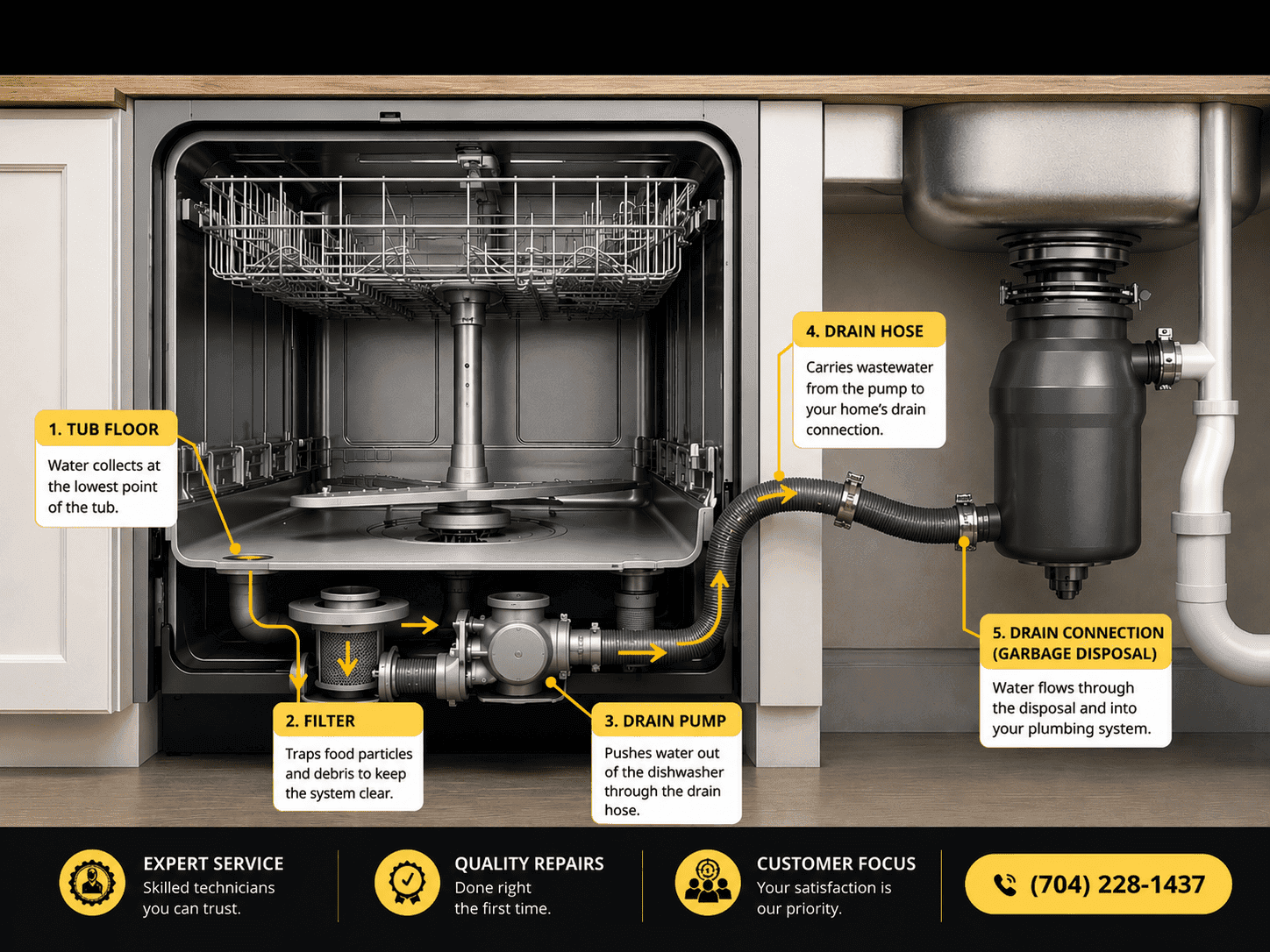
The short answer is that water is supposed to drain through the drain hose at the end of each cycle. When it does not, something along that drainage path is blocked, broken, or failing. The cause could be as simple as a clogged food filter or as involved as a failed drain pump. Either way, the water is not moving because something is stopping it.
Most people assume the worst immediately, but what we typically find is that the issue is one of a handful of very common culprits. Understanding each one helps you figure out whether this is a quick DIY fix or something that needs a trained technician.
What Is Blocking Your Dishwasher Drain
Is a Clogged Filter the Reason Your Dishwasher Has Standing Water?
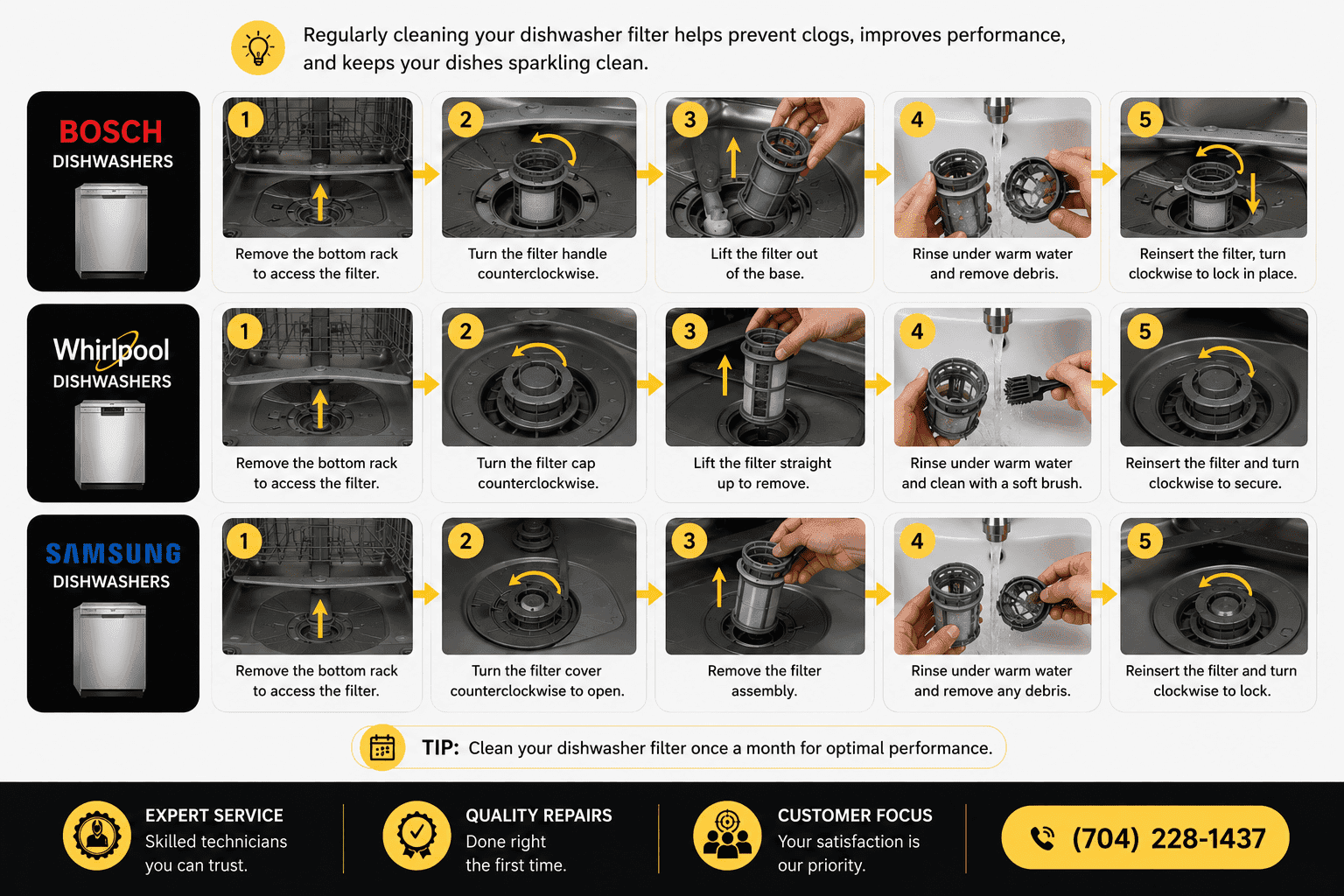
Yes, and this is probably the most common cause of all. Most modern dishwashers have a manual filter located at the bottom of the tub, usually a cylindrical mesh piece you can twist out by hand. Over time, food particles, grease, and debris accumulate in this filter. Once it gets fully packed, water simply cannot pass through it fast enough during the drain cycle, and you end up with that familiar puddle of dishwasher standing water.
If your dishwasher is not draining and you have not cleaned the filter in the past few months (or ever), that is the first thing to check. Here’s how:
- Remove the bottom rack completely
- Locate the cylindrical filter at the base of the tub
- Twist it counterclockwise and lift it out
- Rinse it under warm running water with a soft brush
- Reinstall it and run a short cycle to test
If the filter looks relatively clean and you still have standing water, the blockage is somewhere else in the system.
Could a Dishwasher Drain Clog Further Down the Line Be the Problem?
Absolutely. Even if your filter is clean, a dishwasher drain clog can form inside the drain hose itself. The drain hose connects the bottom of your dishwasher to either the garbage disposal or the drain pipe under your sink. Over time, grease, soap buildup, and food residue harden inside the hose and create a partial or full blockage.
Signs that point toward a clog in the drain hose specifically:
- Water drains slowly rather than staying completely stagnant
- You notice a sour or sewage-like smell coming from the dishwasher
- The issue started gradually and got worse over several weeks
- Water is backing up into the dishwasher from the sink side
You can sometimes clear a partial hose clog by disconnecting the hose (with the water supply off) and flushing it out, but if the clog is deep or the hose has kinks, replacing it is often the more practical solution.
What Happens When the Garbage Disposal Connection Is Blocked
If your dishwasher drains into a garbage disposal, there is one specific issue that catches a lot of homeowners off guard. When a brand new garbage disposal is installed, there is a plastic knockout plug inside the dishwasher inlet port that must be removed before connecting the drain hose. If that plug was never removed, your dishwasher has been trying to push water into a sealed port.
Even on older disposals, the inlet port can become blocked with accumulated food waste, especially if the disposal is not used regularly. If your dishwasher drainage problem started around the same time you had disposal work done, or if your disposal itself has been acting up, check that connection before assuming the dishwasher is at fault.
If you need help with the disposal side of things, our team handles garbage disposal repair and can assess the full drainage setup while on-site.
Is the Drain Hose Installed Correctly
This one gets overlooked surprisingly often. The drain hose on your dishwasher needs to loop up high before it connects to the disposal or drain pipe. This high loop, or in some installations a dedicated air gap fitting on the countertop, prevents wastewater from the sink from siphoning back into the dishwasher.
If the hose was installed without this loop, or if the loop has slipped down over time, water can flow backward into the machine. You would notice this as standing water that reappears even after the dishwasher successfully drains, typically after the sink is used.
This is an installation issue, not a mechanical failure, and it is a quick fix once identified.
When the Problem Is Not a Clog, It Is a Component Failing
What Are the Signs of Dishwasher Pump Failure
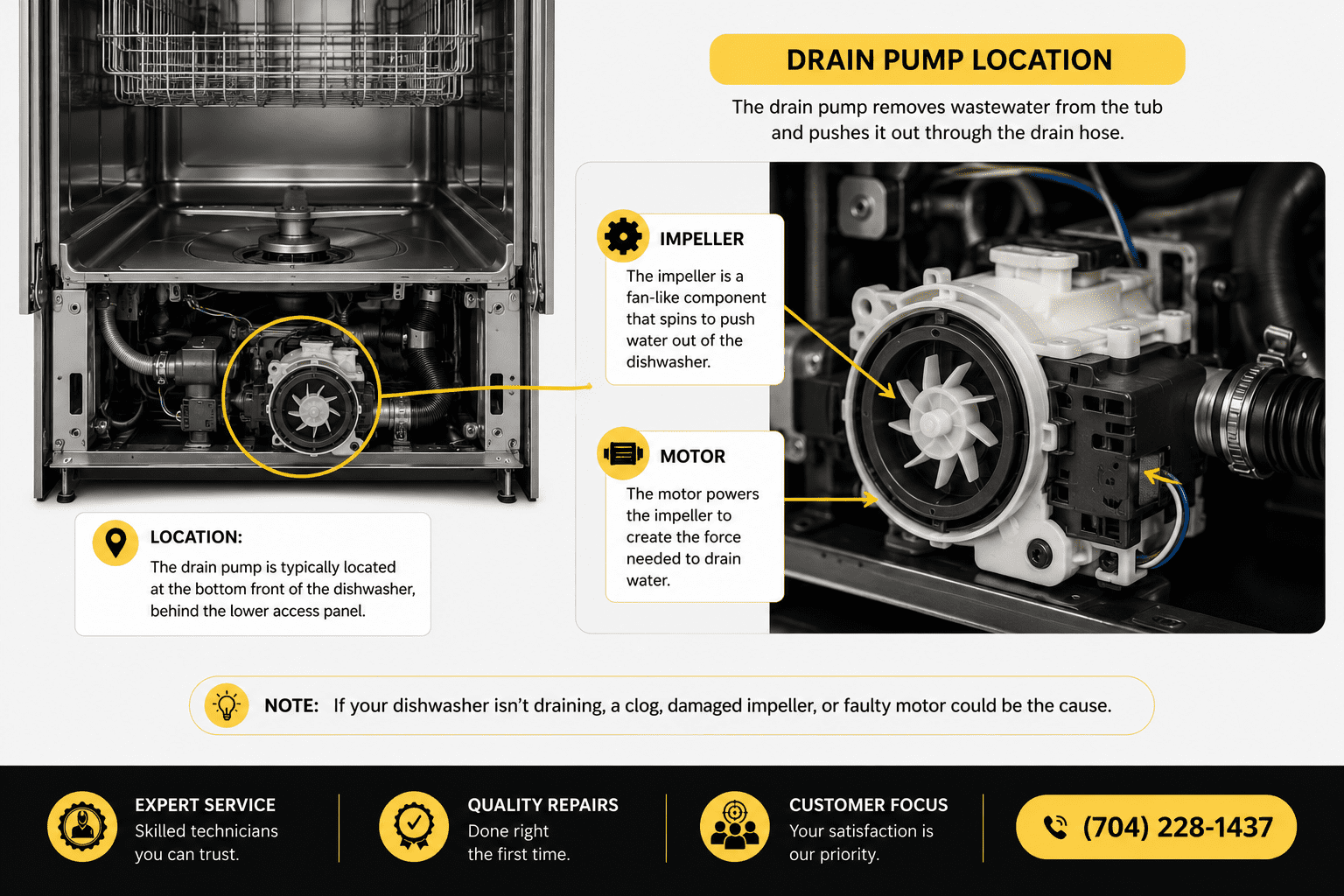
If your filter is clean, the hose is clear, and the disposal connection is fine, the next thing to consider is the drain pump itself. The drain pump is a small motorized pump at the bottom of the dishwasher that forces water out through the drain hose. When it fails, water cannot leave the tub regardless of how clear the drain path is.
Dishwasher pump failure tends to show up in a few recognizable ways:
- You can hear a humming or buzzing noise during the drain cycle but water stays put
- The dishwasher is completely silent when it should be draining
- The pump works intermittently, so sometimes water drains and sometimes it does not
- You notice an error code on your display panel related to drainage (on newer models)
Unlike a clogged filter, pump replacement is not something most homeowners should attempt on their own. It requires accessing the bottom of the unit, disconnecting wiring and hoses, and correctly sourcing a compatible replacement part. Using a non-genuine component can create new problems, which is why we only use authentic parts on every repair.
Could a Faulty Door Latch or Cycle Issue Be Stopping the Drain
Yes, in some cases. Modern dishwashers are controlled by electronic control boards that manage each phase of the wash and drain cycle. If the control board receives a bad signal or has a component failure, it may skip the drain cycle entirely, or start and stop it partway through.
You might also notice that the cycle light shows the dishwasher has completed, but the machine never actually ran a full cycle. Brands like Bosch, Samsung, and LG use diagnostic modes that can flag this kind of issue, though reading those codes usually requires someone familiar with the specific platform.
The Mistakes That Make Dishwasher Drainage Problems Worse
A lot of the clients who come to us have already tried a few things before calling, and some of those attempts make the diagnosis harder or create additional damage. Here are the things worth avoiding:
- Pouring drain cleaner directly into the dishwasher is not a solution. Harsh chemicals can damage rubber seals, the pump housing, and the drain hose, especially on older units.
- Running the dishwasher repeatedly hoping it clears sometimes pushes dirty standing water further through the system and can create a mold or mildew problem inside the door seals.
- Manually scooping water out without diagnosing the cause means the next cycle will produce the same result.
- Ignoring the problem because it seems minor. Water that sits at the bottom of a dishwasher creates bacterial growth, can warp the base of the tub over time, and may eventually overflow and damage your floor and cabinetry.
How to Figure Out Which Problem You Actually Have
Symptom | Most Likely Cause |
Water sits completely still after cycle | Clogged filter or failed drain pump |
Water drains slowly but not fully | Partial drain hose clog or kink |
Water returns after draining | High loop missing, siphon backflow |
Humming noise but no draining | Drain pump motor seized or jammed |
No sound during drain phase | Control board or door latch issue |
Water backs up from sink into dishwasher | Garbage disposal connection blocked |
Standing water with foul smell | Clogged filter and bacterial buildup |
This table covers the most common combinations we see. If your situation matches one of these, that is a solid starting point for diagnosis. If your symptoms do not fit neatly into one category, there may be more than one issue present, which happens more often than people expect on machines that have not had any maintenance in a few years.
What the Repair Process Actually Looks Like
When one of our technicians arrives for a dishwasher not draining call, here is the typical process:
- Visual inspection of the filter, tub floor, and drain area
- Running a short test cycle to observe the drain behavior in real time
- Checking the drain hose routing and disposal or drain pipe connection
- Accessing the pump and checking for obstructions or motor failure
- Checking for error codes if the model supports it
- Providing a clear diagnosis with repair cost before any work begins
We do not start replacing parts before you know what the issue is and what it will cost. That is a basic standard we hold to on every call, whether it’s a straightforward dishwasher drain clog or something more involved like pump failure.
Most dishwasher drainage repairs are completed in a single visit. Same-day service is available in Charlotte, Concord, Hickory, and Winston-Salem when you call early in the day.
How Much Does It Cost to Fix a Dishwasher That Is Not Draining
This depends on what is actually wrong. Here is a general range for the most common repairs:
Repair Type | Typical Cost Range |
Filter cleaning and inspection | Lower cost, often part of diagnostic |
Drain hose replacement | Moderate, parts plus labor |
Garbage disposal reconnection | Low to moderate |
Drain pump replacement | Moderate to higher depending on brand |
Control board diagnosis and repair | Varies widely by model |
The brand and model of your dishwasher affect parts costs significantly. A Bosch or Miele drain pump costs more than a Whirlpool equivalent, simply because the parts are priced differently. We will always give you an upfront estimate before starting any work, so there are no surprises on the invoice.
Is It Worth Repairing or Should You Replace the Dishwasher
This question comes up often, and the honest answer depends on three things: the age of the machine, the cost of the repair relative to replacement, and the condition of the rest of the appliance.
A general rule that works well in practice is this: if the repair cost is less than 50 percent of the replacement value of the machine, and the machine is under ten years old with no other ongoing issues, repair usually makes more sense. Most dishwasher drainage repairs fall well within that range.
If the machine is 12 or more years old and has had multiple issues over the past couple of years, a more candid conversation about whether repair makes long-term financial sense is worth having. We’re straightforward about this with every client because we would rather give you useful advice than push you toward a repair that will not hold.
Why A1 Appliance Home Services for Your Dishwasher Repair
At A1 Appliance Home Services, we’ve handled thousands of dishwasher drainage calls across the Charlotte metro and surrounding communities. We’ve seen every variation of this problem: filters packed solid with grease, drain hoses that were kinked behind cabinetry from day one, pumps that failed on three-year-old machines due to hard water damage, and garbage disposal connections that were never properly set up.
What sets us apart is straightforward: we come with the parts, we give you a clear answer before we start, and we stand behind the repair with a warranty on both labor and components. Our technicians are insured and EPA certified, and they work with all major brands, from Whirlpool and GE to Samsung, Bosch, LG, Miele, and everything in between.
New clients can book online and save $15. We also offer a $15 labor discount for seniors and military personnel. Same-day appointments are available most days.
Ready to Stop Dealing With Dishwasher Standing Water
You shouldn’t have to keep bailing out your dishwasher or running the same load twice hoping it drains on its own. Our team is available today across Charlotte, Concord, Hickory, and Winston-Salem, and we can usually get someone out the same day you call.
Fill out our quick contact form on the contact page or call (704) 307-5004 to schedule your repair. If you’re specifically in Charlotte, you can also book directly through our dishwasher repair Charlotte page. In Concord, visit the dishwasher repair Concord page for local availability.
Frequently Asked Questions About Dishwashers Not Draining
Why is there water sitting at the bottom of my dishwasher after the cycle ends?
Water at the bottom of your dishwasher after a cycle almost always means something along the drain path is blocked or failing. The most common reasons are a clogged filter, a blocked drain hose, a sealed garbage disposal inlet, or a failed drain pump. Starting with the filter is the right first step since it’s the easiest to access and the most frequently missed piece of maintenance.
Can I fix a dishwasher that is not draining myself?
Cleaning the filter and checking the high loop on the drain hose are both things you can do without tools. Beyond that, repairs like hose replacement, pump replacement, or control board diagnosis are best left to a technician. Attempting pump repairs without experience risks damaging the wiring harness or introducing installation errors that cause new leaks.
How do I know if my dishwasher drain pump has failed?
The clearest sign is a humming or buzzing sound during the drain phase without any actual water movement. Sometimes the pump goes completely silent during what should be the drain cycle. If cleaning the filter and checking the hose makes no difference, the pump is the next component to test.
Why does my dishwasher smell bad and not drain properly?
A foul smell combined with standing water almost always means there is food debris decomposing inside the filter, the drain hose, or both. Bacteria grows quickly in stagnant water, especially in the warm environment of a recently run dishwasher. Cleaning the filter thoroughly and running a hot water cycle with a dishwasher cleaner can help with odor after the drain issue is resolved.
Could my garbage disposal be causing the dishwasher to not drain?
Yes. If your dishwasher drains into a garbage disposal, a blocked inlet port will completely prevent drainage. This is especially common on newly installed disposals where the knockout plug was not removed, or on older units where food waste has built up in the inlet. Running the disposal before starting a dishwasher cycle can sometimes help prevent backpressure from partially blocked connections.
My dishwasher drains fine sometimes but not others. What does that mean?
Intermittent drainage problems typically point to a failing drain pump that still functions under some conditions, a partial clog that moves around in the drain hose, or an electronic control issue that causes the drain phase to skip or cut short. These problems tend to get worse over time, so intermittent draining is a signal to get it looked at before it stops working entirely.
How often should I clean my dishwasher filter to prevent standing water?
Most manufacturers recommend cleaning the filter once a month if you run the dishwasher regularly, or every two to three months for lighter use. If you notice your dishwasher is not cleaning dishes as well as it used to, or water is slow to drain, those are signs the filter needs attention regardless of when you last cleaned it.
Is standing water in a dishwasher dangerous?
It is not immediately dangerous to people, but standing water creates real problems for the appliance and your kitchen. Stagnant water promotes mold and bacteria growth inside the tub, can degrade rubber door seals over time, and may eventually overflow and damage your floor, subfloor, and cabinetry. It also puts extra strain on the pump every time the dishwasher runs with that water still present.
What brands of dishwashers do you repair?
Our technicians work with all major brands including Whirlpool, GE, Samsung, LG, Bosch, KitchenAid, Miele, Maytag, Frigidaire, Electrolux, and more. Brand-specific diagnostics and genuine replacement parts are standard on every job. You can find the full list of brands we service on our dishwasher repair page.
How quickly can A1 Appliance Home Services fix my dishwasher drainage problem?
Same-day service is available most days across Charlotte, Concord, Hickory, and Winston-Salem. Most dishwasher drainage repairs are completed in one visit. Call (704) 307-5004 or fill out the form on our contacts page to check availability.

